Wm. B.Tilton Guitar
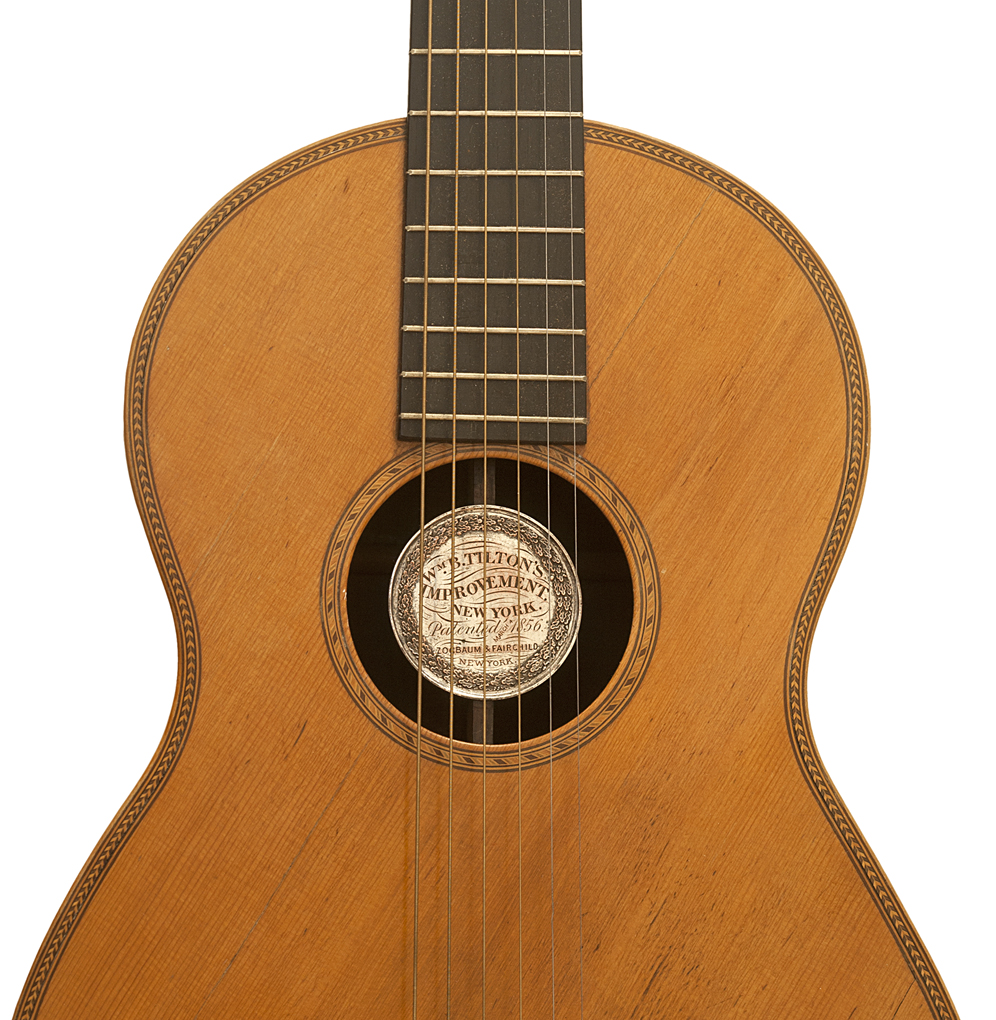
Wm. B. Tilton "Improvement", New York, Patented March, 1856
By Zogbaum & Fairchild
The patented Tilton Improvement was available to be installed in all makes of guitars. One example has been seen in a late 1830's Martin.
Tilton guitars are built with a unique diagonal grain.
Tilton guitars were built early on by the John C. Haynes Co., which was founded in 1865 in Boston, Massachusetts when Oliver Ditson, a prominent Boston music publisher, acquired a stock of musical instruments from bankruptcy, and let his new partner William Haynes run this new business as an offshoot of the Oliver Ditson Company. Soon Haynes started producing the Tilton guitars under license, in the shop of Swedish luthier Pehr A. Anderberg. Haynes eventually bought out Anderberg's shop, growing into a major builder of guitars, including Bay State and many other brands, with a factory of 25 men.
Martin built guitars for the Charles Ditson Store, another offshoot started by Oliver's son, for nearly thirty years.
Zogbaum and Fairchild grew from the firm of Ferdinand Zogbaum in Charleston, South Carolina before moving North to New York and including his son Rufus Fairchild Zogbaum.
The Zogbaum and Fairchild name appears on all Tilton Improvement medallions, including those on the guitars built by Haynes. It is unclear if Zogbaum and Fairchild actually manufactured the medallions.
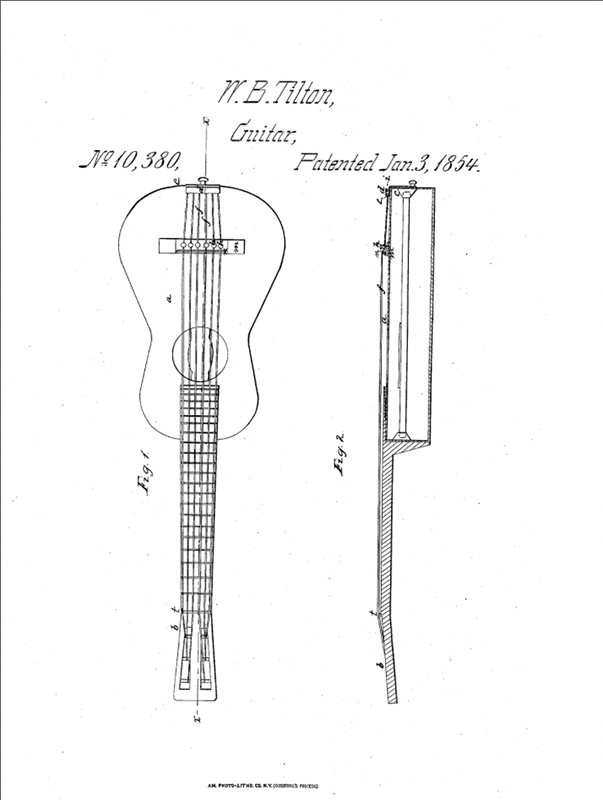
The January 3, 1854 Patent #10380 was for the dowel inside the guitar, similar to the dowel in a banjo, and really the precursor to the metal rod inside the Larson Brother's Prarie State Guitars. It stabilizes and take the pressure of the strings off the body without dampening the sound produced from the top.
UNITED STATES PATENT OFFICE.
WILLIAM B. TILTON, OF NEW YORK. N. Y.
GUITAR.
Specification of Letters Patent No.
10,380, dated January 3, 1854.
To all whom t may concern Be it known
that I, VILLIAM B. TILroN, of the city, county, and State of N
ew York, have invented a new and useful Improvement in
Guitars; and I .flo hereby declare that the following is a
full, clear, and exact description of the construction and
operation of the same, reference bring had to the annexed
drawings, forming part of this specification, in which- Figure
l is a face view of the instrument, and Fig. 2 is a section on
line of Fig. 1, taken perpendicular to the sounding hoard.
Similar letters of reference in the
several figures denote the same part of the instrument.
The object of my invention is to
stretch the strings of the guitar, so as to give greater
vibration to the sounding board, and consequent clearness of
tone to the instrument.
It consists in attaching the strings to
the foot of the guitar, and carrying them through perforations
in permanent pins, at the usual place of fastening, and over a
bridge directly in front of said pins to the head of the
instrument, thus rendering the strings incapable of lateral
movementon the bridge, and giving an additional length of
string between the pins and foot; the bridge becoming a
fulcrum for increasing the tension of the strings, by the
downward action of the pins, thus giving the requisite tension
of string between the head and the usual point of attachment,
with the advantage gained in tone by the additional string
between the pins and foot.
In the drawings a is the sounding
board, Z) the head and c the foot of the instrument. Fastened
to the foot is the broad hooked plate CZ, having in it the
holes c through which the strings f pass while the knots z' on
their extremities are drawn against the inner face of the hook
as shown in Fig. 2. The strings f pass through the pins 7L
fastened in the bridge piece m, and over the bridge n to the
head of the instrument where they are drawn tight by the usual
arrangement of screws. Instead of the separate pins h there
may be used a single piece fastened to the bridge piece m,
with holes the proper distance apart to accommodate the
strings; or, there may be a straight bar placed the proper
distance above the bridge piece m, under which the strings
shall be carried before they are passed over the bridge n, the
modifications having the effect o1 the perforated pins zy in
drawing the strings over the bridge n.
By the above described arrangement, the
requisite degree of tension is obtained between the bridge n
and the nut t, while the fastening of the strings at the foot
and carrying them over the bridge a, precludes the necessity
of the bracing usually required under the sounding board,
which always has a tendency to injure the tone of the
inst-rument.
I am aware that strings have been
fastened at the foot of guitars or similar instruments, but in
all such cases there is either no bridge, or if one be used,
the strings pass loosely over it, and move laterally as each
chord is struck, producing a discordant twanging sound, and
preventing the benecial elfects which should result from
fastening the strings at the foot. This disadvantage I obviate
by the use of the perforated pins it, or their equivalent, so
as to cause the strings to rise over the bridge n and receive
the requisite tension, while the relief thus given to the
sound board causes the instrument to have a full, clear, and
prolonged tone.
By my invention I give the requisite
ten-i sion to the usual length of string, upon which every
note is made, and by the additional length of string between
the pins and the foot, together with the relief of the sound
board from obstruction, produce a vibration which gives a
fullness and richness of tone not obtained on any instrumentv
of this character.
To enable the instrument` to be made in
the lightest manner and still bear the increased tension due
to the extension of string I use the device secured by my
patent of September 2d 1851, though for the applic-a tion of
the present improvement it is not absolutely necessary that
the invention covered by that patent should be employed. I do
not claim extending the strings from the foot to the head of
the instrument-. But That I do claim as my invention and
desire to secure by Letters Patent, is
Depressing the strings of guitars
slightly below the bridge` by passing them through
perforations in the ordinary pins or pegs t or by any means
substantially the same, when the strings are fastened at the
foot of the instrument, for causing the bridge to not signed
my naine before two subscribing witas a fuioruln, 1n producing
the tension of nesses.
the strings and so relieving the sound
board 7 y T K f M. B. l`ILlOi\. as to give the instrument a
richer, fuller 5 und a more complete tone as herein fully set
/Tltnesses:
forth. ROBERT H. JOHNSTON,
In testimony whereof, I have hereunto
ALFRED CHANCELLOR.
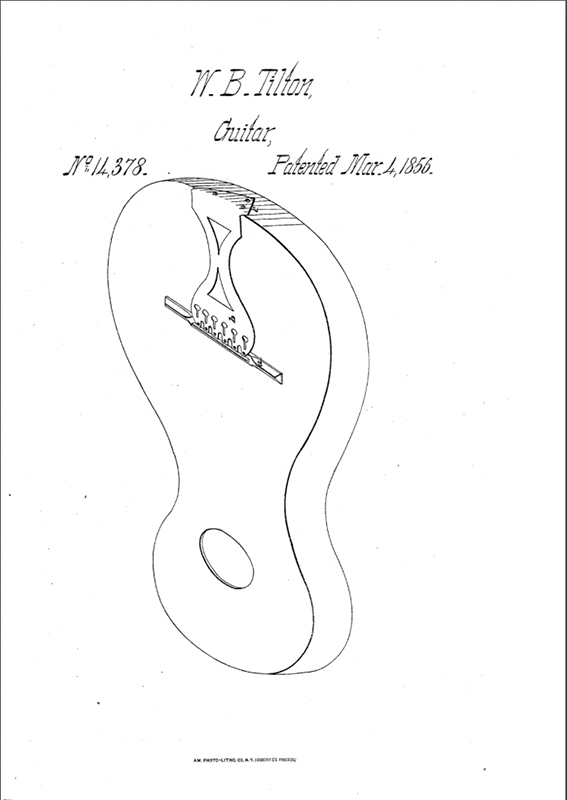
The March 4,
1856 Patent #11378 was for the tailpiece which threads the
strings through the bridge .
UNITED STATES PATENT OFFICE.
WM. B. TILTON, OF NEIV YORK, N. Y.
GUITAR.
Specification of Letters Patent No.
14,378, dated March 4, 1856,
also adds to the strength of the
instrument and improves the action of the bridge, enabling me
to dispense with one-half or more of the material formerly
required therefor, making it narrow and short, so as to give
the utmost effect to the power of the instrument and materials
employed.
The following is a description of it-s
construction and operation and the difference between it and
guitars in use heretofore, .reference being had to the
accompanying drawing by letter.
In the ordinary guitar a very large
bridge is required to sustain the strain of the strings and
give space to fasten the pegs into, which hold them; it
consequently covers a large portion of the soundboard and so
far weakens its vibratory power, besides which the great
strain brought upon the soundboard also injured its effect; to
obviate this difficulty felt to be so radical I made my
improvement which I patented in January 1854:. This produced a
marked change on the instrument for the better and at once
raised my instruments in character, but a diligent and
expensive series of experiments has developed a. new and
useful improvement which I now ask a patent for.
It consists in reducing the bridge a
down to a minimum size simply for purpose of pressure and then
connecting it by means of a plate b of metal, or other
suitable maferial, that does not touch the soundboard, but
lies just above it, with the rim at the end c. This tail piece
is in form like that of a violin but it differs from it in
this respect, it is bent down over the end and screwed
immovably to the rim at its rear end while its front end is
permanently affixed to the bridge before named thus uniting
the bridge and rim together by a second bridge or tail piece
that spans over the soundboard without touching it. The
strings are attached as in the ordinary violin without the
intervention of pegs.
I am aware that tail pieces have been
old and well known appliances on stringed instruments and I do
not lay claim to such a device; but
That I do claim as my invention and
desire to secure by Letters Patent is The combination of the
bridge and rim of a guita-r or other stringed instrument by a
tail piece firmly attached to both substantially in the manner
and for the purposes set forth by which much of the strain is
taken from the bridge and its size greatly reduced as above
specified, by which the f tone of the instrument is improved.
IVM. B. TILTON. lVitnesses J. O.
GREENOUGH, IV. PENDLETON.
vintagemartin.com
To See Robert Corwin's Classic Photography of Folk and Roots Musicians, visit:
To See Robert Corwin's Classic Photography of Folk and Roots Musicians, visit:
For Information on Photography for
Exhibition, Publication, CD's, Promotion, Web Pages, Tour Books,
to Purchase Photographic Prints, or
If You Have Questions or Suggestions About This Web Site or Vintage Martin Guitars:
e-mail: Robert Corwinentire site copyright ©1998 through 2026 Robert Corwin/Photo-Arts. All rights reserved.